The purpose of this blog is to combine philosophy and psychology to explore and explain human nature. Each post is centered around an opinion I've developed based off of extensive research and observation, but I definitely don't know everything. The main purpose of each post is not necessarily to educate, but to spark thought and debate. So if you have a conflicting opinion or theory, comment! Thanks for reading!(:

Sunday, May 3, 2015

Philosophy: Two Paradoxes of God's Existence


Today’s post is on two philosophical paradoxes of God’s existence: one that proves it, and one that disproves it.  The first paradox is called The Ontological Argument. . .


St. Anselm was an 11th century philosopher who used logic and reasoning to prove God’s existence.  He invented The Ontological Argument, which is a dialogue between him and a character named “The Fool”.  The Fool is an atheist who understands the concept of God, but doesn’t believe that God actually exists.

The argument is based off of two givens: that God is “the being of which nothing greater can be thought” and that existence in reality is superior to existence in the mind.

The Ontological Argument:

Anselm:
If God existed he would be the greatest thing
that could possibly be—“the being of which
 nothing greater could ever be thought”, correct?

The Fool:
Yes.

Anselm:
And the concept of God exists in
your mind, correct?

The Fool:
Yes, He exists in my mind, not in reality.

Anselm:
But which is greater: something that exists in
reality, or something that exists solely in your mind?

The Fool:
Something that exists in reality is greater than
something that exists solely in my imagination.

Anselm:
So “the being of which nothing greater can
be thought” would be greater if it existed in reality,
 and not just in your mind, correct?

Fool:
Yes.

Anselm:
But the being of which nothing greater can be
thought cannot be greater than it already is!  That
would contradict its very nature as “the being of
which nothing greater can be thought”!  Therefore,
God exists not only in your mind but in reality as well.


Yikes, that was a lot to take in. . .

So let’s break it down.  Here is what we need to know:

    1. That God is the being of which nothing greater can be thought, meaning that we can’t possibly think of anything greater than God.  He’s it.  He’s just the best. 

   2. According to The Fool, God exists in the mind, but not in reality, meaning that though we may believe in God, he merely exists in our imaginations and not in the real world. 

   3. Both Anselm and The Fool agree that an object that exists in both the mind and reality is greater than an object that exists solely in the mind.

The conclusion of these three statements: God would be greater if he existed in both realms, as opposed to solely the realm of thought.

The Fool agrees with the three numbered statements and ultimately the underlined fourth statement, but not all statements can be true at once.

If 1 and 2 are true, then 3 can’t be true.

If 2 and 3 are true, then 1 can’t be true.

If 1 and 3 are true, then 2 can’t be true.


No matter how you look at it, the statements cannot all be true at the same time, rendering the Fool’s argument invalid, and therefore proving God’s existence.


And now for Epicurus’ argument. . .
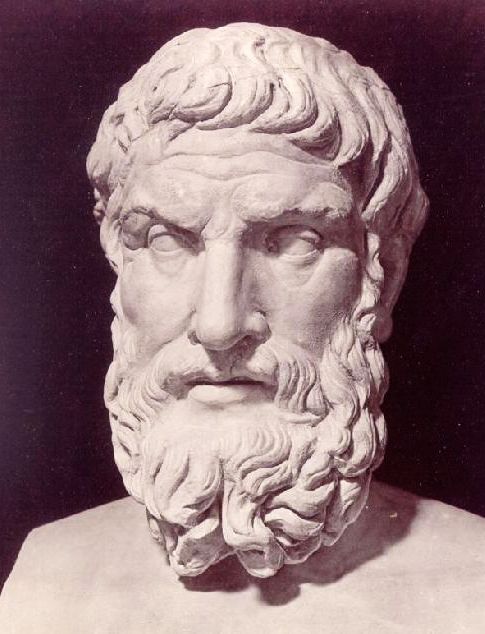
 

Epicurus was an ancient Greek philosopher who, like Anselm, was interested in the concept of God.  However, Epicurus used logic and reason to disprove God’s existence. . .

Epicurus’ Four Statements:

1.     Is God willing to prevent evil, but not able? 
Then he is not omnipotent.

2.     Is he able to prevent evil, but not willing? 
Then he is malevolent.

3.     Is he both able and willing? 
Then whence cometh evil?

4.     Is he neither able nor willing? 
Then why call him God?


Epicurus’ Four Statements rely on three assumptions:
1.     The God we believe in is all-powerful.
2.     The God we believe in is good.
3.     Evil exists in the world.

So the basic questions raised by the Four Statements are

If God has the will to prevent evil and the power to do so, why is there evil?

If God doesn’t have the will or power to prevent evil, then why is he a God?


So what do you guys think?  Which philosopher do you agree with? Both?  Neither?  Explain your reasoning. . .

Dialogue of Ontological Argument Paraphrased from The Philosophy Book: Big Ideas Simply Explained

Thursday, April 30, 2015

Theseus' Paradox: Are You Still You?


Image result for theseus ship paradox cartoon

Theseus is known as a legendary ancient Greek king who is the supposed founder of Athens.  He appears in many myths and legends, but is most famous for his ship: the Ship of Theseus.  It was a grand ship that was gifted to him by the people of Athens and preserved as a memorial to him for hundreds of years.  Over time, however, one of the ship's planks began to rot.  So the plank was promptly replaced.  A little while later, another plank began to rot, so that plank was replaced as well.  Eventually, after years and years and years of this, none of the planks were the same.  Each one had been replaced at some point or another.  The question: is it still the same ship?

If your answer is no, then at what point does it stop being the same ship?  Once the first plank is replaced?  The last?  Halfway through?


If your answer is yes, then why?  If the ship had been taken apart and put back together with completely different pieces all at once, then would it still be the same ship?  Or does it only apply when the change is gradual?


Now, consider this:
Cells in your body do the same thing the planks do.  They die out, and they're replaced.  After about seven years, each cell in your body has been replaced and none of the original cells remain.  


Are you still the same person?  If so, why?


Psychology: 3 Reasons Why Girls Play Dumb


“To know nothing is the happiest life”
                    -Desiderius Erasmus

The topic of today’s post is slightly more psychological than philosophical, but can still be applied to both subjects.  It’s something that’s important to me because I see it all around me, and I see others perpetuating it.  We are annoyed with and hate the girls that do it, yet we give them no choice.  The topic of today’s post?  Girls who play dumb.

We’ll start with this: humans have an intrinsic desire to fit into a group.  This is due mainly to evolution—we are pack animals, so we must remain with a pack in order to survive.  But why do many girls feel like stupidity is the road to acceptance?  Why do girls play dumb?  Well, I believe that the first reason is this:

1.  Insecurity about true extent of intelligence

A girl who is insecure about her intelligence and genuinely believes that she is stupid is more likely to play up that aspect of her personality and pretend to be more stupid than she honestly is.  Boiled down to a couple sentences, her basic thought process is this:

“If I try to be smart, people will tell me I’m stupid, and therefore I’ll know I am stupid.
If I try to be stupid, people will tell me I’m stupid, but they just don’t realize that I’m only playing stupid, and therefore I might still be smart.”

If a girl feels like she will be shot down either way, then she has absolutely no incentive to try to be intelligent.  She feels as though her best option is to accept and embrace her stupidity.  Because according to society, the only thing more annoying than a simply stupid person is a stupid person that tries to be smart.

2. Societal gender roles

Intelligence is not a traditionally feminine trait.  Moreover, on a mental level, the testosterone in men makes them psychologically more aggressive, and the estrogen in females makes them psychologically more submissive.

This matters because it is usually the less assertive girls who begin to play dumb.  They don’t feel safe asserting their opinions and ideas, especially if those opinions and ideas oppose those of others.  In addition, girls take many psychological cues from society and the media telling them that intelligence and femininity are mutually exclusive, and therefore feel as though they can make themselves more feminine and more desirable by playing dumb.

3. The Media

When we watch TV shows and movies or read stories, we are constantly being presented with the stereotypical motley crew of friends containing every single stereotype known to man, enjoying their antics and living in happy harmony.  There’s the Smart Friend, the Attractive Friend, the Morally Upright Friend, etc.

And there is always, always the Stupid Friend.

The Stupid Friend is usually a fun, likable character designed for comedic relief.  He or she induces a lot of empathy from the audience, and at the same time makes the audience feel good about the extent of their own intelligence.  The worst part is that in female characters, the Stupid Friend often doubles as the Attractive Friend, making the idea of personifying this character all the more appealing.

If a girl is insecure, she may think to herself,

“I’m definitely not intelligent enough to be the Smart Friend, and based on my looks alone I’m definitely not pretty enough to be the Attractive Friend.  I’m not even sure if I’m a good enough of a person to be the Morally Upright Friend.  Therefore. . . I must be the Stupid Friend, right?

If a girl feels like she doesn't have a place, the character of the Stupid Friend is simply the easiest to embody, because what’s easier than being stupid?  As we learned from Desiderius Erasmus, ignorance is the simplest, happiest life. . .
. . .For the most part, at least.


Tuesday, April 28, 2015

Free Will vs Determinism (and why it matters to us)


This is a topic that I’ve devoted a lot of time and thought to, and I’m going to be honest:

I don’t think I believe in free will.

That’s right.  Mom, Dad, I think I’m. . .                                       
. . .a determinist.

I say “I think” because I believe that we as people definitely have the power to do what we want—we just don’t have the power to want what we want.  Allow me to explain--

Most philosophers think of determinism in terms of all things that occur in the universe, but because my purpose is to combine philosophy with psychology so as to better understand people, I’m going to focus primarily on determinism and what it means in terms of human behavior.  There are thousands of details that go into explaining exactly what determinism is, all using physics and metaphysics and the laws of the universe and whatnot.  But for now I’ll discuss the concept in the way that I’ve interpreted it, which is to say in the simplest terms possible.

Let’s start with this: it is impossible for you to think a completely random thought.  Yes, it may be random in that it’s irrelevant to what’s currently happening or what we’re currently talking about.  But it’s not a purely random thought.  This is because of one simple fact:

The brain needs input to make output.

If it is impossible for your brain to think of a random thought, how can you possibly make yourself do a random action?  Make a random decision?  Though it may feel random, it can’t be, simply because of the way our minds were made.

Now, keep this concept in mind throughout these next few paragraphs. . .

Allow me to make a slight digression to discuss two forces that shape our lives. Personality is the result of two basic ingredients: nature and nurture. Your nature is the qualities you were born with, meaning you brain chemistry, genetics, etc.  If your parents are naturally intelligent people, then you are likely to be a naturally intelligent person as well, because you have inherited that from your parents.  Hormones are factors as well—testosterone can make a person more aggressive, oxytocin can make a person more clingy, etc.  Chemicals in the brain can make us overeaters, more optimistic, more susceptible to depression. . . the list is endless.  Your nature is a very significant influence in who you are and the decisions you make, and has been in action since the second you were born.

Then we have nurture, which is basically anything you experience from the second you're born and onward.  Almost anything about us, from our irrational fears to our weird sexual fetishes, are due to what we’ve experienced, mainly as children.  The second you emerge from the womb, you are not in control of your environment or of what happens to you.  Your brain is simply too young to be capable of real decision-making, but it begins almost immediately taking psychological cues about what the world is like and how to be a part of it.

So let’s circle back to that “The brain needs input to make output” idea.  Every decision you make, starting when you’re just a baby, is not random.  It is the result of the only two ingredients you are made of: your nature and your nurture.  The older you get, the more experiences you will have had and the more decisions you will have made, all influencing what goes on in your brain when you make any decision.

But why should you care?  Well, let me tell you why I started caring.

Think of someone you hate.  That person who just seems to be all of your pet peeves bundled up into one sad disgrace for a human being.

Now, whether you believe in determinism or not, you can’t deny that that person is at least partially the result of many factors that have been completely out of their control since birth.  If they’re mean, unintelligent, self-obsessed—all their qualities can be traced back to their brain chemistry and their experiences.  Every time we judge somebody, we have to realize that that person is the way that they are for very specific reasons.  They were born with a completely different set of genes than us and have had completely different experiences than us, leading them to do and believe completely different things.

And why don’t we like this person?  Well, because we too have different genes and different experiences that led us to form certain opinions that caused us to dislike certain traits in other people.  We can’t help it if we don’t like these traits, but other people can’t help it if they have them.

Maybe you’re still a steadfast believer in free will and the idea that the decisions we make are 100% up to us and not predetermined by forces beyond our control.  I respect that and can’t tell you that you’re wrong, because we really have no idea and no way to prove either concept.  However, though the idea of Determinism may not succeed in swaying your ideas on free will, I think it’s still an important concept when analyzing people and their behaviors.  It makes it easier to withhold judgment, increase empathy, and be more open-minded while delving into questions about why people are the way that they are.