

Today’s
post is on two philosophical paradoxes of God’s existence: one that proves it,
and one that disproves it. The first
paradox is called The Ontological Argument. . .

St.
Anselm was an 11th century philosopher who used logic and reasoning
to prove God’s existence. He invented The
Ontological Argument, which is a dialogue between him and a character named
“The Fool”. The Fool is an atheist who
understands the concept of God, but doesn’t believe that God actually exists.
The
argument is based off of two givens: that God is “the being of which nothing
greater can be thought” and that existence in reality is superior to existence
in the mind.
The
Ontological Argument:
Anselm:
If
God existed he would be the greatest thing
that
could possibly be—“the being of which
nothing greater could ever be thought”, correct?
The Fool:
Yes.
Anselm:
And
the concept of God exists in
your
mind, correct?
The Fool:
Yes, He exists in my mind, not in reality.
Anselm:
But
which is greater: something that exists in
reality,
or something that exists solely in your mind?
The Fool:
Something that exists in reality is greater than
something that exists solely in my imagination.
Anselm:
So
“the being of which nothing greater can
be thought” would be
greater if it existed in reality,
and not just in your mind, correct?
Fool:
Yes.
Anselm:
But
the being of which nothing greater can be
thought
cannot be greater than it already is!
That
would
contradict its very nature as “the being of
which
nothing greater can be thought”!
Therefore,
God
exists not only in your mind but in reality as well.
Yikes,
that was a lot to take in. . .
So
let’s break it down. Here is what we
need to know:
1. That God is the being of which nothing greater
can be thought, meaning that we can’t possibly think of anything greater
than God. He’s it. He’s just the best.
2. According to
The Fool, God exists in the mind, but
not in reality, meaning that though we may believe in God, he merely exists
in our imaginations and not in the real world.
3. Both Anselm
and The Fool agree that an object that
exists in both the mind and reality is greater than an object that exists solely
in the mind.
The
conclusion of these three statements: God
would be greater if he existed in both realms, as opposed to solely the realm
of thought.
The
Fool agrees with the three numbered statements and ultimately the underlined
fourth statement, but not all statements can be true at once.
If
1 and 2 are true, then 3 can’t
be true.
If
2 and 3 are true, then 1 can’t
be true.
If
1 and 3 are true, then 2 can’t
be true.
No
matter how you look at it, the statements cannot all be true at the same time,
rendering the Fool’s argument invalid, and therefore proving God’s existence.
And
now for Epicurus’ argument. . .
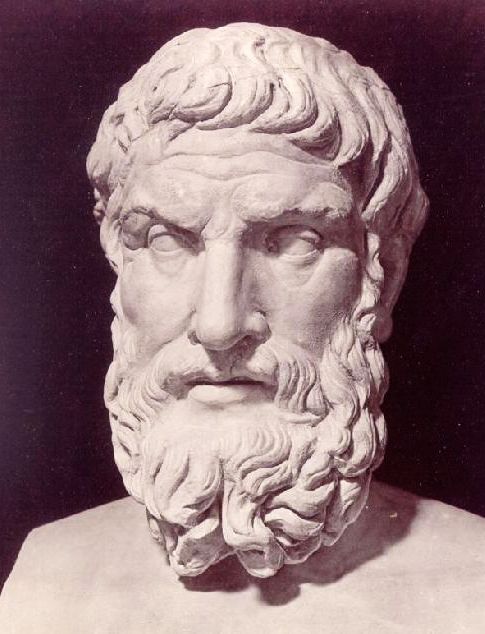
Epicurus
was an ancient Greek philosopher who, like Anselm, was interested in the
concept of God. However, Epicurus used
logic and reason to disprove God’s
existence. . .
Epicurus’
Four Statements:
1. Is God willing to prevent evil, but not
able?
Then he is not omnipotent.
2. Is he able to prevent evil, but not
willing?
Then he is malevolent.
3. Is he both able and willing?
Then whence cometh evil?
4. Is he neither able nor willing?
Then why call him God?
Epicurus’
Four Statements rely on three assumptions:
1. The God we
believe in is all-powerful.
2. The God we
believe in is good.
3. Evil exists
in the world.
So
the basic questions raised by the Four Statements are
If God has the will to prevent evil and the
power to do so, why is there evil?
If God doesn’t have the will or power to prevent
evil, then why is he a God?
So
what do you guys think? Which
philosopher do you agree with? Both?
Neither? Explain your reasoning.
. .
Dialogue of Ontological Argument Paraphrased from The Philosophy Book: Big Ideas Simply Explained
